Heads up: this article includes Amazon affiliate links. We are an Amazon Associate and earn from qualifying purchases, which never changes what you pay.
Buy the ZELCAN Magnetic Drill Press with 6 if you drill into steel beams on job sites and need a machine that anchors itself without clamps. Skip it if your work is mostly wood, aluminum, or non-magnetic metal. For fabricators moving between structural frames daily, this press removes slow bolted-stand setup because its solid iron bottom acts as a 3125 lbf electromagnet at the flick of a switch.
For the workshop owner doing occasional heavy drilling, the stepless control knob lets you match the exact speed each bit needs, which protects both the cutter and the steel. The reversible direction switch adds flexibility for clearing chips or backing out stuck bits. A 16.9 fl. oz. coolant tank feeds fluid directly to the cutting edge, managing heat during deep passes up to 2″ in depth. The central trade-off here is clear: the machine’s entire mounting system relies on ferrous surfaces, so it cannot grip stainless steel, aluminum, or wood, limiting where you can use it. If your projects demand drilling across mixed materials, you’ll need a traditional bench press instead.
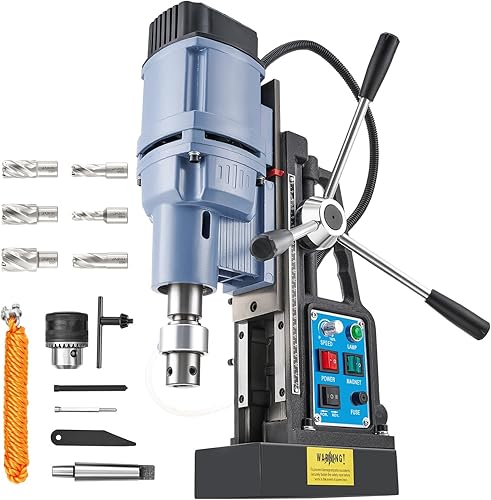
Who should buy this magnetic drill press
This drill press suits three specific buyers who work with heavy steel regularly. First, consider the structural fabricator who builds bridges or ships. These workers drill thick plates daily, often in positions where a standard bench press can’t go. The listing names ship and bridge building directly, alongside industrial and steel fabrication. Because the solid iron bottom generates 3125 lbf of magnetic force, the machine locks onto vertical beams or overhead girders without extra clamps. That holding power lets one person position the drill, flip the switch, and start boring holes up to 2″ in diameter safely. The fabricator won’t waste time bolting down a stand before every cut.
Second, the field technician installing equipment on power plants or windmills fits this tool well. The listing highlights windmill and power-plant construction, plus equipment installation. These jobs happen outdoors, often high up, where carrying heavy support gear slows the crew down. The manufacturer claims light weight and portability, meaning the tech can carry the press up a ladder or crane hook. Once on the steel surface, the electromagnet secures it instantly. The generous 16.9 fl. oz. coolant tank helps here too, because field work rarely offers a nearby water line for cooling. The built-in tank feeds fluid straight to the bit, preserving precise drilling even when you’re far from a shop sink.
Third, the railway maintenance worker boring holes in tracks or rolling stock will find the reversible direction switch useful. Railway manufacture is listed as an intended application. When drilling hardened rail steel, chips can bind the bit. Reversing the motor backs the cutter out cleanly. Combined with the stepless control knob, the worker can dial down the 650 rpm maximum to match the tough alloy, preventing burnt edges.
However, two buyers should leave this press alone. If you build custom furniture from aluminum extrusions or wood, the electromagnet won’t hold. The listing specifies it bores into almost any ferrous surface, meaning non-magnetic metals are off limits. You’d need a mechanical clamp press instead. Likewise, if you only drill thin sheet metal occasionally, the 1550W copper motor and 13900N magnetic force are more than the job requires. Look for a smaller, mechanically mounted drill for thin-gauge tasks.
What this mag drill actually does
Every feature on this machine serves one of four jobs for the person running it. Here’s how the listed specs translate into what you get done on the steel.
Locking onto steel without clamps
The core job of any magnetic drill is staying put while the bit bites into metal. This press handles that task through its solid iron bottom, which the manufacturer says acts as a powerful electromagnet. When you flip the switch, it generates 3125 lbf of holding force, also rated at 13900N. That number matters because drilling a 2″ hole creates massive rotational torque. At 3125 lbf, the magnet resists that twisting force on flat, clean ferrous surfaces.
The listing emphasizes that this anchoring happens despite the machine’s light weight and portability. Traditional drill presses rely on heavy cast-iron bases to stay stable. This design shifts the stability burden to the electromagnetic bond, letting you carry the tool to the workpiece rather than dragging the workpiece to a bench. The condition here is strict: the surface must be ferrous. The manufacturer lists ship building, bridge building, and railway manufacture as targets, all of which use carbon steel.
Boring large holes through thick metal
Once anchored, the machine’s second job is removing metal quickly and cleanly. The listing points to a 1550W copper motor spinning at 650 rpm. The stated capacity reaches 2″ in diameter and 2″ in depth. That depth limit means you can pass completely through standard structural I-beams or heavy plate in a single operation.
To support this cutting action, the package includes 6 drill bits. The manufacturer states these let you create holes in most common sizes, saving you from sourcing annular cutters separately before your first shift. Having six sizes ready means less downtime swapping tooling when a blueprint calls for different bolt patterns across the same beam. The 650 rpm rating represents the top speed. Larger diameter bits require slower rotation to prevent burning the cutting edges, which leads directly into how the operator controls that pace. The motor’s power is fixed, but the speed isn’t, giving you the ability to match the cutter to the material thickness.
Matching speed and direction to the cut
Drilling steel isn’t a one-speed task. The third job this press performs is giving the operator fine control over the cutting action. The listing describes a stepless control knob for smoothly adjusting drilling speed. Unlike a gearbox with three or four fixed settings, stepless control lets you set the exact rpm required for your specific bit diameter and steel hardness. Running a small bit too slowly causes rubbing instead of cutting; running a large bit too fast melts the edge. The knob eliminates those guesswork gaps.
Equally important is the direction switch, which allows you to reverse drilling direction. Forward rotation cuts the metal. Reverse rotation serves several purposes on a job site. If a bit binds in a deep hole, reversing backs it out without snapping the shank. If you’re using a tap after drilling, reverse withdraws it cleanly. The manufacturer notes this supports a wide range of tasks beyond simple through-holes. Together, the stepless knob and the direction switch mean the operator dictates the feed, rather than forcing the material to accept a single fixed behavior. This level of control is what separates dedicated mag drills from adapted hand drills, because the operator can react to changes in the steel’s density mid-cut.
Keeping the bit cool under load
Friction generates intense heat when cutting steel, and heat destroys drill bits. The fourth job is thermal management. The listing highlights a generous 16.9 fl. oz. coolant tank. This reservoir holds cutting fluid and feeds it directly to the cutting zone during operation. The manufacturer claims this efficiently manages heat, preserving precise drilling and prolonging the machine’s life.
On a large structural project requiring dozens of holes, that volume determines your work rhythm. The system is integrated into the press, meaning you don’t need an external pump or a helper squirting fluid by hand. The tank sits on the machine, gravity or internal pressure feeding the fluid down around the bit.
For the complete list of specifications, refer to the details below.
| # | What Amazon lists |
|---|---|
| 1 | Superior Performance: The Creworks magnetic drill press boasts a powerful 1550W copper motor, drilling at a rapid 650 rpm and handling holes up to 2″ in depth and 2″ in diameter. It includes 6 drill bits for you to create holes in most common sizes. |
| 2 | 13900N Magnetic Force: Despite its light weight and portability, this mag drill anchors itself securely during use through its solid iron bottom which acts as a powerful 3125 lbf electromagnet at the flick of a switch. |
| 3 | Stepless & Reversible Control: Smoothly adjust your drilling speed with our stepless control knob to match your exact required speed. The handy direction switch allows you to reverse drilling direction for a wide range of tasks. |
| 4 | Efficient Cooling System: Thanks to its generous 16.9 fl. oz. coolant tank, this magnetic drill press efficiently manages heat, preserving precise drilling and prolonging the machine’s life. |
| 5 | Tackle Most Surfaces with Ease: This magnetic drilling machine allows you to bore into almost any ferrous surface, ideal for ship & bridge building, industrial and steel fabrication, windmill & power-plant construction, railway manufacture, equipment installation and more! |
Strengths and limits of this drill
Pros
- 1550W copper motor drives holes up to 2″
- The high-force electromagnet anchors securely to steel
- Stepless knob adjusts speed smoothly without fixed gears
- Includes 6 drill bits for common hole sizes
- 16.9 fl. oz. coolant tank feeds fluid during cuts
Cons
- Only grips ferrous metal surfaces, not aluminum
- Maximum drilling depth stops at 2 inches

Should you mount this on your steel
Buy the ZELCAN Magnetic Drill Press with 6 if your daily work involves boring holes into carbon steel structures and you need to move the drill to the metal, not the other way around. Skip it entirely if your projects involve wood, plastic, or non-magnetic alloys like aluminum.
For the structural fabricator working on bridges or ships, this machine earns its place. The powerful magnetic force locks the base to girders instantly, removing the need for bolted clamps that slow down production. You get a 1550W copper motor capable of pushing 2″ cutters through thick plate, paired with six included bits so you can start immediately. The stepless speed control lets you dial back from the 650 rpm maximum when larger diameters demand slower feeds, protecting both the tool and the workpiece.
For the field technician installing equipment at power plants, the portability and self-contained cooling make sense. This unit travels light, anchors with a switch, and uses its built-in 16.9 fl. oz. coolant tank to manage heat without external plumbing. The reversible direction switch allows you to back out stuck bits when they bind in deep holes.
The central compromise is material dependence. The entire mounting strategy fails on anything that isn’t ferrous. If your shop handles mixed materials—aluminum frames, steel plates—this press sits idle often. In that case, look for a mechanical radial arm drill press that clamps physically rather than magnetically. Given the robust copper motor specification and the complete accessory package including coolant delivery and a full set of cutters, this press delivers exactly what steelworkers require, provided their material never changes.
Related guides
- VEVOR 12 in Benchtop Drill Press Review: Verdict
- 10-Inch Benchtop Drill Press- Variable Speed Review: Verdict
Frequently Asked Questions
Does it work on aluminum or stainless steel?
No, it doesn’t. The manufacturer states this machine bores into almost any ferrous surface. Aluminum and austenitic stainless steel aren’t ferrous, meaning they won’t activate the electromagnet at all. If you need to drill non-magnetic metals, you must use a press with mechanical clamps or a vacuum base designed for those specific alloys.
Are the six drill bits annular cutters or twist drills?
The listing includes an assortment of drill bits for most common hole sizes but doesn’t specify whether they are annular cutters or twist drills. Given the 2″ maximum diameter, larger sizes typically require annular cutters. Verify the shank type matches your chuck before buying replacements.
How do I know the magnet is holding safely?
The solid iron bottom acts as an electromagnet at the flick of a switch. Before starting the motor, perform a pull test by trying to slide the base by hand. If it shifts easily, grind the contact area flat and clean until the 13900N force engages fully. Never trust a weak hold overhead.
Is a magnetic drill really necessary for metalwork?
Yes, if you drill large holes in fixed structures frequently. A bench press requires bringing heavy beams to the machine, which is impossible on construction sites. This category solves both problems by bringing factory-level rigidity directly to the beam. If you only drill small holes occasionally, a standard cordless drill suffices, but for structural fabrication, the magnetic base is essential.
Conclusion
If you’re tired of wrestling clamps on every new beam, this machine’s ready to work. Grab a fresh annular cutter, lock the base onto your next steel frame, and start drilling. You’ll wonder how you ever managed without that instant hold.