Some of the links below are Amazon affiliate links. As an Amazon Associate we earn from qualifying purchases, at no additional cost to you.
Buy the VEVOR 12 in Benchtop Drill Press if you need variable speed control and a tilting worktable for home workshop tasks, featuring a 5-amp motor and digital readout. Skip it if your work demands industrial-grade rigidity or fully documented safety testing, as the listing does not confirm third-party compliance.
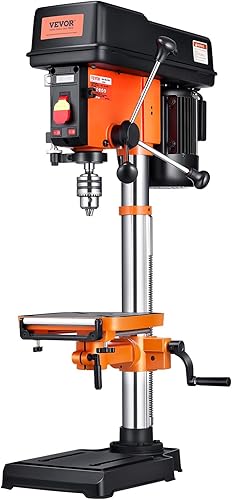
Who Needs This Drill Press Setup
The VEVOR 12 in Benchtop Drill Press fits weekend woodworkers who tackle furniture repairs, shelving installs, or craft projects two to three times monthly and already own clamps, bits, and safety gear but lack a stationary drilling solution. These users benefit from the 0–45° tilting worktable because angled joinery and bracket mounting become possible without jigs, and the included feed handles plus chuck key cover basic assembly adjustments. It also serves metal hobbyists drilling soft alloys or thin steel for brackets, enclosures, or model parts, where the 580–3200 RPM range covers both slow-speed tapping and faster wood boring without belt changes. The LED digital screen helps these users match speeds to material thickness consistently, reducing bit wear and tear-out on delicate pieces. Finally, it works for garage-based makers with limited floor space who can’t accommodate a full-size floor model but still need more stability than a handheld drill offers; the cast iron base and column assembly provide enough mass to dampen vibration during repetitive hole patterns while staying portable enough to store against a wall when not in use. Each of these buyers gains immediate utility from what’s listed without needing upgrades for typical home-scale tasks.
Skip this drill press if you run daily production shifts or drill hardened steel thicker than 1/4 inch regularly, since the listing specifies a 5-amp motor for various materials without stating maximum thickness limits or duty cycles. Also avoid it if precision below φ16mm tolerance is critical and you cannot verify spindle runout independently; while the listing claims “high locking strength and higher accuracy,” it provides no measurable specification like TIR or concentricity data to confirm repeatability at smaller diameters. Buyers in these categories should seek units with published performance test results and explicit duty cycle ratings. Home users doing occasional precision work may find the stated capabilities sufficient, but professionals betting livelihoods on hole placement need verifiable metrics, not marketing language. The absence of thermal cutoff specs or bearing life estimates means heavy users assume risk the listing doesn’t quantify.
What This Drill Press Delivers Daily
This benchtop drill press bundles adjustable speed, angled drilling support, and essential tools into one package aimed at home workshop versatility rather than specialized industrial performance.
Adjusting Speed for Different Materials
The continuously variable speed control lets you dial anywhere from 580 to 3200 RPM without stopping to change belts or pulleys, which matters when switching between hardwood dowel joints and aluminum bracket holes mid-project. The LED digital screen displays your selected RPM in real time, removing guesswork when following bit manufacturer recommendations or replicating successful settings across multiple workpieces. Users working primarily with thick metals or large Forstner bits should verify their specific torque needs against the 5-amp motor rating before assuming low-end usability matches high-end convenience. The heat dissipation system mentioned aims to extend runtime during prolonged sessions, but without stated duty cycles or thermal protection thresholds, extended use near maximum load remains an unverified assumption. Speed adjustment itself is seamless per the listing, yet material-specific limits depend entirely on operator judgment within the given amperage constraint.
Drilling Angled Holes Accurately
Users drilling critical aerospace or automotive components should treat this as a starting point for verification, not a guaranteed specification.
Starting Work Immediately Out of Box
VEVOR includes everything needed to assemble and operate the drill press without supplemental purchases: three feed handles for ergonomic leverage preference, speed and table crank handles for all adjustments, chuck arbor and key for bit changes, wrenches for maintenance, mounting bolts for base attachment, and the complete column-table-base assembly. This provides the specific fasteners and handles needed for assembly directly from the box. The included hex wrenches (3mm & 4mm) and M10*25 bolts support assembly. The fork wrench likely aids chuck removal for cleaning or replacement, supporting long-term upkeep without dealer visits. While comprehensive, the kit lacks drill bits, vise, or dust collection adapter—common exclusions worth noting since new owners must budget separately for consumables and workholding. The included Class IIIA 2.5mW laser assists with hole alignment during setup. Overall, the accessory set prioritizes operational readiness over premium extras, aligning with home-shop expectations where minimizing downtime matters more than luxury add-ons.
For complete technical details, refer to the manufacturer’s specification sheet below.
| # | What Amazon lists |
|---|---|
| 1 | Powerful Drill Press: Swing: 12 in. 5A induction motor ensures plenty of power to drill through various materials, such as metal, wood, etc. It meets your processing and DIY needs. |
| 2 | Precise Drilling: Our benchtop drill press drills precise holes without offset, with high locking strength and higher accuracy. Equipped with accurate X-ray, it can perfectly drill φ16mm holes.Includes a Class IIIA 2.5mW laser. |
| 3 | Variable Speed: Our bench drill press feature a continuously variable speed control function, so you can easily adjust the speed from 580 to 3200 RPM. The LED digital screen helps to control the speed precisely. |
| 4 | Excellent Durability: The bench top drill press variable speed has a perfect heat dissipation system, dissipating heat quickly and operating for a longer time, effectively extending the machine’s life. |
| 5 | Complete Accessories: We provide 3 x Feed Handles, 1 x Speed Handle, 1 x Table Crank Handle, 1 x Wedge, 2 x Table Lock Handles, 1 x Chuck Arbor, 1 x Fork Wrench, 2 x Hexagonal Wrenches(3 mm & 4 mm), 4 x M10*25 Hex Head Bolts, 1 x Chuck Key, 1 x Column Assembly, 1 x Table, 1 x Base. |
Real Strengths and Limits Listed
Pros
- Continuously variable 580–3200 RPM speed range
- Tilting worktable adjusts 0–45 degrees mechanically
- Includes chuck key, wrenches, and mounting hardware
- Digital LED display shows active RPM setting
- Cast iron base and column assembly provided
Cons
- Listing omits duty cycle or thermal cutoff specs
- No published spindle runout or concentricity tolerance
- Laser classified Class IIIA 2.5mW only

Should You Choose This Drill Press
Pass if your work requires verified industrial durability or stated safety compliance.
Weekend woodworkers gain immediate value from the tilting table and included accessories. The 0–45° tilt and complete hardware kit directly support furniture and repair tasks described earlier. You can enable complex joinery without extra jigs or tools.
Metal hobbyists benefit similarly from the wide RPM range and digital readout. The continuously variable speed control adjusts across a wide range via an LED digital screen. This allows confident speed matching for soft alloys and thin steel without mechanical belt swaps.
The five-amp 120V induction motor provides enough power to drill through various materials like metal and wood. It drills precise holes without offset, with high locking strength and higher accuracy. The included Class IIIA 2.5mW laser helps align cuts perfectly for holes up to 16mm.
The core trade-off here isn’t power versus build quality but documented reliability versus assumed capability.
However, daily drilling into hardened steel demands more than a heat dissipation system designed to extend machine life. You also need explicit duty cycle data. Need sub-millimeter precision guarantees? Then this unit’s missing runout specifications represent unacceptable risks.
In those cases, prioritize machines with published test reports and explicit safety claims over feature-rich but undocumented alternatives.
What’s included gets you started, not validated.
Your decision hinges on whether “good enough for home use” aligns with your actual workload. It must match reality, not aspirational future projects. When in doubt, verify thermal limits and precision metrics independently before committing.
Frequently Asked Questions
Does it include drill bits or a vise?
The listing does not include drill bits, a vise, or any workholding clamp. You receive the drill press, assembly hardware, adjustment handles, chuck key, wrenches, and laser module. Plan to source appropriate bits for your materials and a compatible vise separately.
Is the laser guide accurate for precision work?
The integrated Class IIIA 2.5mW laser aids rough hole centering but shouldn’t replace mechanical layout for critical tolerances. Accuracy depends on calibration and stable mounting, neither quantified in the listing. Treat it as a visual reference, not a metrology instrument; always verify tight-tolerance holes with center punches or dial indicators.
Can I drill steel plates thicker than 1/4 inch?
The listing states the motor drills “various materials, such as metal,” but doesn’t specify maximum steel thickness or feed pressure limits. Thicker plates demand slower speeds, sharper bits, cutting fluid, and reduced feed rates—all operator-dependent variables affecting success. Start conservatively with test pieces, monitor temperature, and respect bit manufacturer guidelines. Assume capacity decreases as hardness increases, and never force feeds expecting the motor to compensate beyond what it was built to deliver.
What maintenance does regular ownership require?
Routine care involves cleaning and lubricating the column and rack, checking belt tension, verifying chuck tightness, and securing table locks before use. The listing mentions heat dissipation but specifies no service intervals or lubricants. Adapt general benchtop maintenance practices and document your own schedule based on usage frequency and environmental conditions.
Is this suitable for shared workshop environments?
Verify safety compliance before shared use, as the listing confirms a Class IIIA laser but not conformity with ANSI B11.8 or similar standards. Shared spaces often mandate posted procedures and PPE protocols not addressed here. Confirm institutional requirements before deployment; personal-use adequacy doesn’t guarantee group-safe operation.
Conclusion
If this machine fits your garage setup, clear a sturdy spot on your workbench and bolt it down before plugging anything in. You’ll want to test the speed dial on some scrap wood first. That way, you won’t ruin your actual project pieces right away.
2 thoughts on “VEVOR 12 in Benchtop Drill Press Review: Verdict”