What Is The Swing On A Drill Press?
A drill press is a must-have tool in many workshops, from woodshops to metalworking stations. If you are looking to buy a drill press or want to use one more effectively, you’ll often see a term called “swing” in the technical specifications. For many, this word seems confusing at first. Yet, understanding what the swing on a drill press means is essential if you want to choose the right machine for your needs. This article will break down the meaning of swing, why it matters, how it affects your projects, and what to look for when comparing drill presses.
The Basics: What Is Swing On A Drill Press?
The swing of a drill press is a simple measurement, but it has a big impact. Swing is the maximum diameter of a workpiece that can be drilled at its center on a drill press. In other words, it tells you how wide a piece of material you can place on the drill press and still reach the exact middle with the drill bit.
This dimension is usually measured in inches (for example, a “12-inch drill press”). The number refers to twice the distance from the center of the spindle (where the drill bit is held) to the closest edge of the column (the round vertical support at the back of the drill press). So, if that distance is 6 inches, the swing is 12 inches.
Key point: The swing does not mean how far the table can move or the size of the table itself. It is only about the distance between the spindle and the column, multiplied by two. This number tells you the largest circle you can drill through the center on that press.
Why Is Swing Important?
Project Limitations
The swing determines the maximum size of material you can drill a hole in the center. For example, if you have a 12-inch drill press, you can drill a hole in the exact center of a 12-inch wide board or disc. If your material is wider than the swing, you cannot reach the center with the drill bit. This is critical if you work with large boards, plates, or need to drill at a precise position.
Comparing Drill Presses
Swing is one of the main ways to compare drill presses. A larger swing means you can handle larger workpieces. Smaller swing models are more portable and take up less space but limit your options for bigger projects.
Example
Imagine you want to drill the middle of a 10-inch circular metal plate. You need a drill press with at least a 10-inch swing. If your drill press only has an 8-inch swing, you will not be able to reach the center, no matter how you adjust the table or the position of the plate.
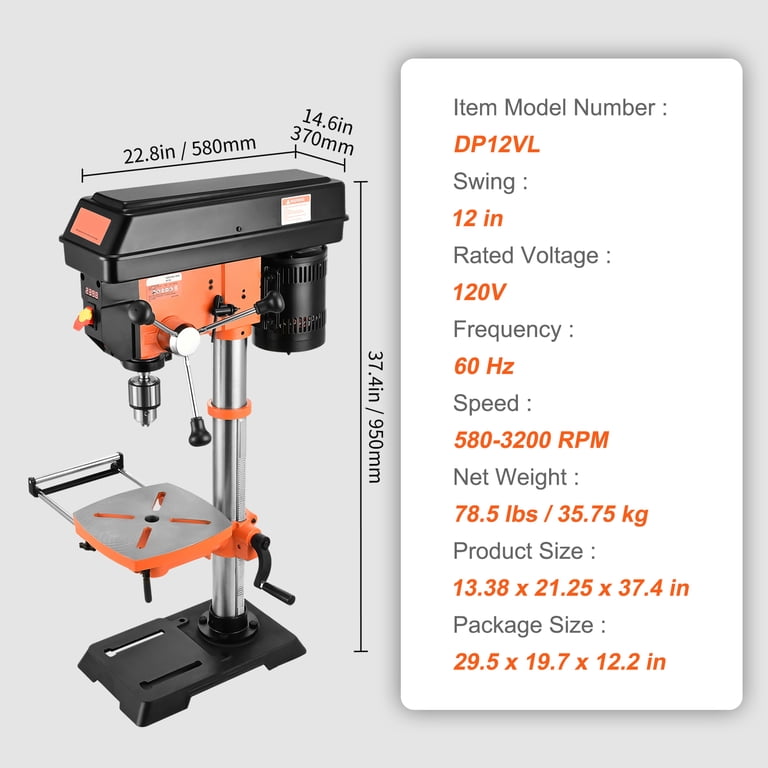
Credit: www.walmart.com
How Is Swing Measured?
The swing is measured as follows:
- Measure the distance from the center of the spindle (the part that holds the drill bit) to the closest edge of the column at the back of the drill press.
- Multiply this distance by two.
For example, if the distance is 7 inches, the swing is 14 inches.
This simple measurement is the industry standard for almost all bench-top and floor model drill presses. Manufacturers always provide the swing in their product specifications.
Common Swing Sizes
Drill presses come in a variety of swing sizes. Here are some typical examples:
| Drill Press Type | Common Swing Sizes |
|---|---|
| Small Benchtop | 8–10 inches |
| Medium Benchtop | 12–14 inches |
| Floor Model | 15–20+ inches |
Smaller benchtop models are good for hobby work or smaller parts. Larger floor models, with swing sizes over 15 inches, are used in professional workshops for bigger projects.
Swing Vs. Other Drill Press Specifications
It’s important not to confuse swing with other measurements you’ll see:
- Throat depth: This is the distance from the spindle center to the column. The swing is twice this number.
- Table size: The size of the platform that holds your workpiece. This does not affect the swing.
- Spindle travel (quill travel): How far the drill bit can move down into your material.
- Motor power: How powerful the drill is. It does not affect the swing.
Here’s a comparison of key drill press specs:
| Specification | What It Means | How It Affects Use |
|---|---|---|
| Swing | Max diameter to drill in center | Limits workpiece size |
| Table Size | Width and length of work support | Limits workpiece support, not center reach |
| Spindle Travel | Vertical movement of drill bit | Limits drilling depth |
| Motor Power | Horsepower or amps | Limits material hardness/thickness |
Insight: Many beginners believe a bigger table means they can drill bigger materials. In fact, only the swing decides if you can reach the center.
Real-world Examples Of Swing
Woodworking
If you’re building a wooden clock and need to drill the exact center of a 14-inch round face, you’ll need a drill press with at least a 14-inch swing. A 10-inch drill press will only reach the center of up to a 10-inch piece.
Metalworking
Suppose you need to drill a hole in the center of a large steel plate for a machine part. If your plate is 16 inches across, only a drill press with a 16-inch swing or larger will do the job.
Hobby Uses
Model makers and small electronics builders can often get by with an 8-inch or 10-inch drill press, since their workpieces are small. But as projects grow, swing becomes more important.
How To Choose The Right Swing For Your Needs
Buying a drill press is an investment. The right swing size depends on your projects, workspace, and budget.
Step 1: Know Your Workpiece Sizes
List the largest materials you plan to drill. For example, do you ever work with:
- Large wooden panels?
- Metal plates for automotive work?
- Small electronics boards only?
Choose a drill press with a swing just larger than your biggest workpiece. If you often work with 12-inch boards, a 12- or 14-inch swing is ideal.
Step 2: Consider Future Projects
It’s common to outgrow a small drill press. If you plan to expand your work, consider a model with a larger swing than you need right now.
Step 3: Think About Space And Cost
Larger swing drill presses are heavier, take up more room, and cost more. Make sure you have the space and budget for a larger machine if you need it.
Step 4: Match Swing With Other Specs
Don’t focus only on swing. Make sure the table size, spindle travel, and motor power also fit your needs. A large swing is useless if the drill isn’t powerful enough for your material.
Pro tip: For most home workshops, a 12-inch or 14-inch swing is a good balance between size, cost, and capability.
:max_bytes(150000):strip_icc()/DB_1892-88aa27e721824b5898c048f63891a2cd.jpg)
Credit: www.woodmagazine.com
Common Mistakes When Understanding Swing
Even experienced users sometimes misunderstand swing. Here are some mistakes to avoid:
- Confusing swing with table size: The table may be large, but if the swing is small, you can’t drill the center of big pieces.
- Ignoring spindle travel: If your material is thick, make sure the drill press can reach all the way through.
- Buying too small: Trying to save space or money, many buy an 8-inch drill press and later find it’s too limited.
- Assuming bigger is always better: Very large swing drill presses take up lots of space. Only buy what you truly need.
How Swing Affects Common Workshop Tasks
Drilling Wide Boards
A drill press with a small swing can only reach near the edge of wide boards. For example, with an 8-inch swing, you can drill to the center of an 8-inch board. If your board is 12 inches wide, you can only drill holes up to 4 inches from the edge.
Making Wheels Or Discs
If you build things like wooden wheels, clock faces, or round plates, you need a drill press with a swing larger than the diameter of your discs. Otherwise, you will not be able to drill through the center.
Working With Jigs And Fixtures
Some jigs or drill guides require extra space. If your swing is too small, you may not be able to use certain attachments or clamps.
Working With Metal Plates
In metalworking, parts often need holes in precise locations. If your drill press swing is too small, you’ll need to drill by hand—losing accuracy and safety.
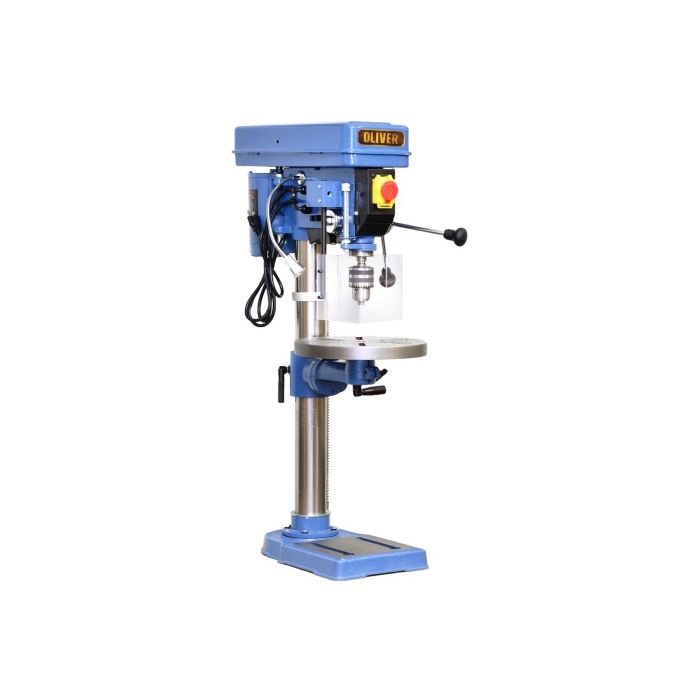
Credit: olivermachinery.net
How To Measure The Swing On Your Drill Press
If you have a drill press and want to check its swing:
- Unplug the machine for safety.
- Raise the drill bit all the way up.
- Use a ruler or tape measure to measure the distance from the center of the spindle to the closest edge of the column.
- Multiply that number by two.
This is your drill press’s swing. For example, if the distance is 6. 5 inches, the swing is 13 inches.
Swing And Drill Press Types
There are several types of drill presses. The swing varies by type.
Benchtop Drill Press
- Swing: Usually 8 to 14 inches
- Pros: Small, portable, cheaper
- Cons: Limited to small and medium workpieces
Floor Drill Press
- Swing: 15 to 20+ inches
- Pros: Can handle large parts, more powerful
- Cons: Heavy, expensive, takes more space
Magnetic Drill Press
- Swing: Not defined the same way (uses a magnet to stick to steel for portable drilling)
- Useful for: Large steel construction, not for typical workshop use
Radial Arm Drill Press
- Swing: Adjustable arm means you can drill very large workpieces
- Used in: Industrial settings, not common for home workshops
How Swing Influences Price And Quality
Swing is a major factor in the price of a drill press. Larger swing models cost more to build and ship. They also need bigger motors and heavier bases to stay stable.
Price Examples
- 8-inch benchtop drill press: $100–$150
- 12-inch benchtop drill press: $150–$250
- 17-inch floor drill press: $350–$600
Larger swing models may also have more advanced features, like variable speed controls or laser guides.
Insight: If you are just starting out, don’t overspend on a huge swing unless you know you will use it. Quality matters more than size for many projects.
Swing And Drilling Accuracy
A bigger swing does not always mean better accuracy. In fact, smaller benchtop drill presses are often more stable for very small workpieces. Larger models can vibrate more unless they are bolted down securely. Always balance swing with the machine’s build quality and your typical work.
Comparing Drill Presses By Swing
Let’s compare three popular models:
| Model | Swing | Spindle Travel | Power | Best For |
|---|---|---|---|---|
| WEN 4208T | 8 inches | 2 inches | 1/3 HP | Small hobby work |
| JET JDP-12 | 12 inches | 3-1/8 inches | 1/2 HP | General workshop |
| Delta 18-900L | 18 inches | 6 inches | 3/4 HP | Professional/large workpieces |
As you can see, swing increases with machine size, but other specs do as well. Choose based on your real needs, not just the biggest number.
What If Your Swing Is Too Small?
If you have a drill press with a swing too small for your project, you have a few options:
- Drill as far toward the center as you can, then finish with a hand drill (accuracy may suffer).
- Flip the workpiece and mark the center from both sides, drilling halfway from each side.
- Take your piece to a larger drill press at a local maker space or workshop.
However, none of these options will give the same accuracy and safety as using the right swing from the start.
Swing And Drill Press Accessories
Some accessories can help you get more from your drill press, but they do not change the swing.
Vises And Clamps
These help hold your workpiece steady, especially when working near the swing limit. Choose a vise that fits your table and does not block the drill bit’s path.
Laser Guides
Some models include a laser crosshair to help you line up your drilling position. This does not affect swing but can improve accuracy.
Rotary Tables
A rotary table lets you rotate your workpiece for multiple holes in a circle. Make sure your workpiece and table fit within the swing.
Swing And Safety
Never try to drill a workpiece that is too large for your drill press’s swing. Forcing a big piece onto a small drill press can cause:
- The piece to tip or fall
- Injury from slipping tools
- Damage to the drill press
Always secure your workpiece, especially when drilling near the swing limit.
Advanced Topics: Modifying Swing
Some advanced users try to “hack” their drill press to increase swing by moving the head along the column (if possible). This is not recommended unless the machine is designed for it. Most drill presses have a fixed head, and modifying it can be dangerous and void warranties.
Radial arm drill presses do allow for adjustable swing but are rare outside of industrial settings.
How Swing Is Labeled By Manufacturers
Manufacturers usually put the swing size in the product name or model number. For example:
- “WEN 4214 12-Inch Drill Press” has a 12-inch swing.
- “Delta 18-900L 18-Inch Laser Drill Press” has an 18-inch swing.
Always double-check the specifications sheet if you are unsure.
Practical Examples: Choosing Swing For Common Projects
Building Furniture
If you build tables or shelves, you may need to drill in the center of wide planks. Measure your widest piece. For example, a 12-inch wide tabletop needs a 12-inch swing.
Automotive Repairs
Drilling into car parts or metal plates often needs a 12- to 16-inch swing, depending on the part.
Jewelry Making
Small pieces can be handled by an 8-inch swing drill press.
Home Repairs
General home repair projects usually fit within an 8- to 12-inch swing.
How Swing Affects Portability
If you need to move your drill press often or have a small workshop, a smaller swing (and therefore, a smaller machine) will be much easier to handle. Large swing machines can weigh 200 pounds or more and are usually fixed in place.
Not All Drilling Needs A Drill Press Swing
For very large materials, or when you need holes far from the edge, sometimes a drill press is not suitable at all. In these cases, use:
- Handheld drills (less accurate)
- Portable magnetic drills for steel
- Take your piece to a machine shop
Key Terms To Know
- Swing: Maximum workpiece diameter for center drilling
- Throat Depth: Distance from spindle center to column
- Spindle Travel: How far the bit moves down
- Column: Main vertical support of the drill press
- Table: Flat surface to hold the workpiece
Understanding these terms will help you read any drill press manual or specification sheet.
Where To Learn More
If you want to read more about drill presses, their specifications, and uses, visit the Drill Press Wikipedia page for a deep dive into the subject.
Frequently Asked Questions
What Does “swing” Mean On A Drill Press?
Swing is the maximum diameter of a workpiece that can be drilled through the center on a drill press. It is twice the distance from the spindle center to the column.
How Do I Measure The Swing On My Own Drill Press?
Measure from the center of the spindle to the closest edge of the column, then multiply by two. That’s your drill press’s swing.
Can I Increase The Swing Of My Drill Press?
For most standard drill presses, swing is fixed. Only special models, like radial arm drill presses, allow for an adjustable swing. Modifying your drill press is not recommended for safety reasons.
Is A Bigger Swing Always Better?
Not always. A bigger swing lets you drill larger workpieces, but larger machines are heavier, more expensive, and take more space. Choose a swing based on your actual project needs.
What Happens If My Workpiece Is Larger Than The Drill Press Swing?
You won’t be able to drill the center of the workpiece. You can only drill as far as the swing allows from the edge. For larger pieces, use a hand drill or find a larger drill press.
Drill press swing is a simple concept, but it has a huge effect on your projects. Whether you’re a hobbyist or a professional, understanding swing helps you choose the right tool, avoid common mistakes, and work more safely and efficiently.
Always measure your needs, check the specifications, and buy the drill press that fits your workshop best.