The Milwaukee half-inch impact wrench is a powerful tool used by professionals and DIY enthusiasts alike. Understanding its torque output, measured in foot-pounds (ft-lbs), is crucial for selecting the right tool for a specific job. This article will break down what foot-pounds mean, how Milwaukee measures it for their tools, and what you can expect from their various half-inch impact wrench models. Whether you’re a mechanic, a construction worker, or a homeowner tackling a tough DIY project, knowing the power of your tools ensures efficiency and safety.
Understanding Foot-pounds Of Torque
Torque is a rotational force. Think of it as the twisting power that an engine delivers to a shaft, or the force you apply when tightening a bolt. Foot-pounds (ft-lbs) is a common unit used in the United States to measure torque. It represents the amount of force (in pounds) applied at a distance of one foot from a pivot point.
What Does Torque Measurement Mean For You?
When you see a torque rating for an impact wrench, it tells you how much twisting force the tool can deliver. This is essential because different tasks require different amounts of force to loosen or tighten fasteners.
- Loosening Bolts: For stubborn, rusted, or overtightened bolts, you need an impact wrench with high torque to break them free.
- Tightening Bolts: When installing fasteners, you need to reach a specific tightness without over-tightening, which can damage the fastener or the material. While impact wrenches are primarily for loosening and rapidly tightening, their torque rating gives you an idea of their maximum fastening power.
Peak Torque Vs. Sustained Torque
It’s important to understand that manufacturers often advertise peak torque. This is the maximum torque the tool can deliver for a very short burst. For practical applications, especially when loosening fasteners, this peak torque is what matters most. However, some tools might offer better sustained torque, meaning they can deliver a strong amount of torque consistently over a longer period. For most users of half-inch impact wrenches, the peak torque rating is the most relevant figure.
Milwaukee’s Half-inch Impact Wrench Lineup And Torque Ratings
Milwaukee Tool offers a wide range of half-inch cordless impact wrenches, each designed for different levels of power and application needs. They categorize their tools within their M12 (sub-compact) and M18 (full-size) battery platforms. The torque figures provided by Milwaukee are typically peak torque ratings, measured under specific testing conditions.
The M18 Fuel™ Line: High Performance
Milwaukee’s M18 FUEL™ line represents their most advanced technology, offering the highest performance for demanding tasks. These tools typically feature brushless motors, which are more efficient and powerful than brushed motors.
M18 Fuel™ High Torque Impact Wrenches
Milwaukee offers several M18 FUEL™ high-torque impact wrenches. These are designed for the most challenging applications, such as removing stubborn lug nuts on heavy-duty vehicles or working on large construction equipment.
- M18 FUEL™ 1/2″ High Torque Impact Wrench (2767-20): This is one of Milwaukee’s flagship models. It is known for delivering up to 1,400 ft-lbs of fastening torque and an impressive 2,000 ft-lbs of nut-busting torque. This high nut-busting torque is crucial for breaking free heavily rusted or seized fasteners. This model typically comes in a compact size for its power, allowing for better access in tight spaces.
- M18 FUEL™ Mid-Torque Impact Wrench (2754-20): While not a “high torque” model, the mid-torque M18 FUEL™ offers a balance of power and size. It typically delivers around 300 ft-lbs of fastening torque and 450 ft-lbs of nut-busting torque. This is suitable for a wider range of automotive and mechanical tasks that don’t require extreme power.
M18 Fuel™ Compact Impact Wrenches
For users who need a good balance of power and maneuverability, Milwaukee offers compact M18 FUEL™ impact wrenches.
- M18 FUEL™ 1/2″ Compact Impact Wrench (2755-20): This model is designed to be lighter and smaller than the high-torque versions, making it easier to use for extended periods or in confined areas. It usually provides around 200 ft-lbs of fastening torque and 300 ft-lbs of nut-busting torque. This is excellent for general automotive repair, such as working on brakes, suspension components, and exhaust systems.
The M12 Fuel™ Line: Compact Power
Milwaukee’s M12 FUEL™ line focuses on delivering impressive power in a much smaller package, utilizing their smaller M12 battery system. These are ideal for mechanics and technicians who need a tool that can fit into extremely tight spaces.
M12 Fuel™ Compact Impact Wrenches
- M12 FUEL™ 1/2″ Ratchet (2555-20): While technically a ratchet, this tool functions similarly to a compact impact wrench for certain applications. It delivers up to 35 ft-lbs of torque and 250 RPM. This is not a direct competitor to the higher torque impact wrenches but is excellent for rapidly removing or installing smaller fasteners where a full impact wrench would be too bulky or too powerful.
- M12 FUEL™ 1/2″ Stubby Impact Wrench (2553-20): This is one of the most popular tools in the M12 line for its size and power. It typically offers around 250 ft-lbs of fastening torque and 350 ft-lbs of nut-busting torque. Its compact head design allows it to access tight engine bays and other confined areas where larger impact wrenches cannot reach.
Understanding Milwaukee’s Torque Specifications
Milwaukee, like most manufacturers, provides peak torque figures. These are often achieved under ideal conditions and can vary slightly depending on the battery’s charge level, the specific motor, and the testing methodology. The nut-busting torque is generally higher than the fastening torque because it’s designed to break a seized fastener loose, while fastening torque refers to the maximum torque for tightening.
Pro Tip: Always check the specific model number on Milwaukee’s official website or the product packaging for the most accurate and up-to-date torque specifications, as these can be updated with new versions of tools.
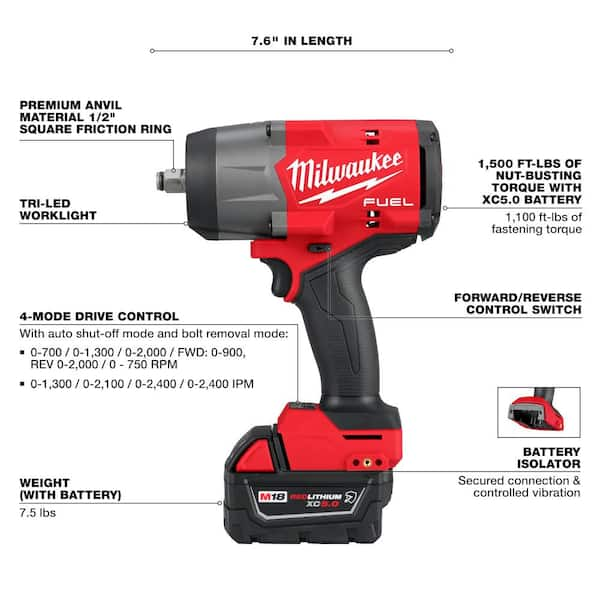
Credit: www.homedepot.com
Factors Influencing Impact Wrench Performance
While the advertised torque rating is a key indicator of an impact wrench’s power, several other factors influence its real-world performance. Understanding these can help you better appreciate the capabilities of your Milwaukee half-inch impact wrench.
Battery Power And Technology
The battery is the heart of any cordless tool. For Milwaukee impact wrenches, the M18 and M12 battery platforms are crucial.
- Voltage: Higher voltage batteries (like the M18’s 18V compared to the M12’s 12V) generally provide more power to the motor, leading to higher torque output and faster operation.
- Amp-Hours (Ah): The amp-hour rating indicates the battery’s capacity, how long it can deliver power. A higher Ah battery will allow you to use the impact wrench for longer periods before needing to recharge, but it doesn’t directly increase the tool’s peak torque.
- Battery Health: An older or damaged battery may not be able to deliver the full power potential of the tool, resulting in lower torque output.
Motor Technology (brushed Vs. Brushless)
As mentioned, Milwaukee’s FUEL™ line utilizes brushless motors. These motors offer significant advantages:
- Increased Efficiency: Brushless motors convert more battery power into mechanical output, meaning less energy is wasted as heat. This translates to longer runtimes and more power.
- Higher Torque: They can typically deliver more torque than brushed motors of the same size.
- Durability: Brushless motors have fewer wearing parts (no brushes to replace), making them more durable and requiring less maintenance.
Tool Gearing And Hammer Mechanism
The internal mechanics of the impact wrench also play a role:
- Gearing: The gear reduction system within the tool transmits the motor’s rotation to the anvil (where the socket attaches). The gear ratio affects the balance between speed and torque.
- Hammer Mechanism: Impact wrenches deliver torque in pulses through a rotating hammer mechanism. The design of this mechanism influences how quickly and effectively torque is applied. Milwaukee’s impact mechanisms are engineered for robust performance.
Anvil Size And Type
The half-inch anvil is standard for these tools, designed to accept half-inch drive sockets. Some models might feature a friction ring anvil for quick socket changes, while others might have a hog ring or detent pin system. The anvil itself is built to withstand high torque.
Operator Technique
While the tool provides the power, how you use it matters:
- Proper Socket Selection: Always use impact-rated sockets. Regular impact sockets are made of a stronger material (like Cr-Mo steel) and are designed to handle the shock and torque of impact wrenches. Standard chrome sockets can shatter.
- Leverage: For extremely tight bolts, sometimes a breaker bar can be used to initially loosen the fastener, making it easier for the impact wrench to finish the job.
- Angle of Attack: Ensure the socket is fully seated on the bolt head and the wrench is perpendicular to it for maximum force transfer and to prevent stripping the fastener.
Choosing The Right Milwaukee Half-inch Impact Wrench For Your Needs
With various models available, selecting the correct Milwaukee half-inch impact wrench depends heavily on the types of tasks you perform most frequently. Consider the torque requirements of your typical jobs.
For The Professional Mechanic
If you work on a variety of vehicles, including trucks and heavy equipment, you’ll likely need the power of the M18 FUEL™ High Torque Impact Wrench (2767-20). Its 2,000 ft-lbs of nut-busting torque is invaluable for stubborn lug nuts, suspension components, and engine work. For lighter automotive tasks like brake jobs, oil changes, and smaller engine components, the M18 FUEL™ Compact Impact Wrench (2755-20) might suffice, offering a good blend of power and maneuverability.
For The Diy Enthusiast / Homeowner
For occasional use on cars, lawnmowers, or general household projects, the M18 FUEL™ Compact Impact Wrench or even the M18 FUEL™ Mid-Torque Impact Wrench can be excellent choices. They offer sufficient power for most common tasks without the higher cost and bulk of the high-torque models. If you are already invested in the M12 battery system and primarily work in tight spaces or on smaller fasteners, the M12 FUEL™ Stubby Impact Wrench could be a surprisingly capable option, though its torque is lower than the M18 counterparts.
For Extreme Tight Spaces
When access is severely limited, such as in some engine bays or under dashboards, the M12 FUEL™ Stubby Impact Wrench is often the go-to. Its compact head and 12V platform allow it to reach fasteners that larger tools simply cannot.
Comparing Key Models
Let’s look at a comparison of some popular Milwaukee half-inch impact wrenches:
| Model | Battery Platform | Max Fastening Torque | Max Nut-Busting Torque | Weight (Tool Only) | Primary Use Case |
|---|---|---|---|---|---|
| M18 FUEL™ 1/2″ High Torque (2767-20) | M18 | 1,400 ft-lbs | 2,000 ft-lbs | ~7.25 lbs | Heavy-duty automotive, construction, equipment |
| M18 FUEL™ 1/2″ Compact (2755-20) | M18 | 200 ft-lbs | 300 ft-lbs | ~3.8 lbs | General automotive, mechanical repair |
| M18 FUEL™ 1/2″ Mid-Torque (2754-20) | M18 | 300 ft-lbs | 450 ft-lbs | ~5.8 lbs | Automotive, general maintenance |
| M12 FUEL™ 1/2″ Stubby (2553-20) | M12 | 250 ft-lbs | 350 ft-lbs | ~2.1 lbs | Tight spaces, automotive, light mechanical |
*Note: Specifications can vary slightly by revision and are approximate. Always check the official Milwaukee Tool website for the most current data.*
Credit: www.milwaukeetool.com
Maintenance And Care For Your Impact Wrench
To ensure your Milwaukee impact wrench continues to deliver its rated foot-pounds of torque for years to come, proper maintenance is essential.
Cleaning
Regularly clean the exterior of the tool with a damp cloth. Avoid using solvents or harsh chemicals, which can damage the plastic housing. Pay attention to the anvil area and remove any dirt or debris that might accumulate.
Battery Care
- Storage: Store batteries in a cool, dry place, away from direct sunlight. Avoid leaving them in extreme temperatures.
- Charging: Use only the Milwaukee chargers designed for your battery platform (M18 or M12). Do not overcharge batteries; modern chargers have built-in protection.
- Inspection: Periodically inspect batteries for any signs of damage, such as cracks or swelling. If a battery looks damaged, discontinue use immediately.
Lubrication (internal)
Most modern Milwaukee impact wrenches, especially FUEL™ models, are designed to be maintenance-free regarding internal lubrication. They come sealed from the factory. Attempting to open and lubricate the gearbox or hammer mechanism yourself can void the warranty and potentially damage the tool if not done correctly. If you suspect an internal issue, it’s best to contact Milwaukee’s customer service or a certified repair center.
Storage
When not in use, store your impact wrench in a dry environment, preferably in its original case or a dedicated tool bag. This protects it from dust, moisture, and accidental damage.
Safety Precautions When Using Impact Wrenches
Using a tool with significant foot-pounds of torque requires attention to safety. An impact wrench can be powerful and, if misused, can lead to injury.
Personal Protective Equipment (ppe)
- Eye Protection: Always wear safety glasses or goggles. Flying debris, metal fragments, or broken sockets can cause serious